
The point of today's brand sprint is to run through different exercises to take abstract ideas surrounding a brand and make them concrete.
We will focus on the three methods, Brand Personality, Brand Positioning Graph, and the Brand Attribute Matrix. However, the methods do not stand alone, one needs to get inspired finding inspiration, create mood boards, research competitors, and use judgement with tools like discussions and voting to complete the sprint.
Later in the semester will we use what will learned here as a foundation to incorporate them into digital tools to manage the brand/user experience through design systems.
Team Roles in the Workshop:
Nominate a "Decider" and a "Documenter".
Decider: For each exercise the decider takes final decisions if there is disagreement and makes sure that the each exercise is completed on time and moves on to the next.
Documenter: For each exercise the documenter takes notes, pictures, etc. keeping taking notes of the progression and documenting the results.
The Brand Sprint consists of:
Inspiration (15 mins): Gather and collect images to generate adjectives for the Brand Personality. There is no correct formula or number but you are interested in getting a diversity of things to talk about. Cars, soft drinks, beer, celebrities, home appliances, movies, abstract textures & shapes, familiar apps and recongizable brands work well.
The images will be used to facilitate a conversation to help to arrive at new adjectives that describe your Brand Personality.
Study (15 mins): Collect and spread out/hang up the gathered images. Individually study each image. Do they exhibit qualities or characterises that are desirable or undesirable. You want to tease out descriptive adjectives, like gloomy, masculine, driven, adventurous. Note the image and the adjective.
Discuss (30 mins): As a team gather the notes and images and facilitate a conversation on the different images, why you chose the adjective and why they are either desirable or undesirable. Have one team member take notes keeping track of the number of times different adjectives come up.

Afterwards tallying up the captured adjectives and write them down on a paper along with the images.

Brand Personality (20 mins): This is used to describe a brand or product as a person. You are imaging your company/product/brand as a person providing a basis and direction for design and market decisions later. Answering the questions from BxID and use the 4-5 key adjectives you arrived at from your inspiration and discussions to describe the person's character:
How old is this person?
Is the person a man or a woman?
To which ethnic group does this person belong?
Where does the person live ( city/countryside, house/apartment, in which city or country)?
Is the person single/married; does he or she have children?
What is the person's occupation, field and position?
What are the person's hobbies and is the person socially committed?
What is the person's political affiliation?
What kind of car does the person drive?
Describe the person's character: introverted, extroverted, loyal...?
Positioning Map (40 mins): A brand position map is a two axis graph which places the brand/product/service in the market to define a target position or gap within a perviously defined space. The results of your Brand Personality are used to build different maps. To build a map start with an adjective from your Brand Personality and create a "slider" by identifying the antimony of the of adjective and place the two on the opposite extremes on a line. Draw where your company/brand/product/service is intended to be. Repeat the process on the different adjectives.
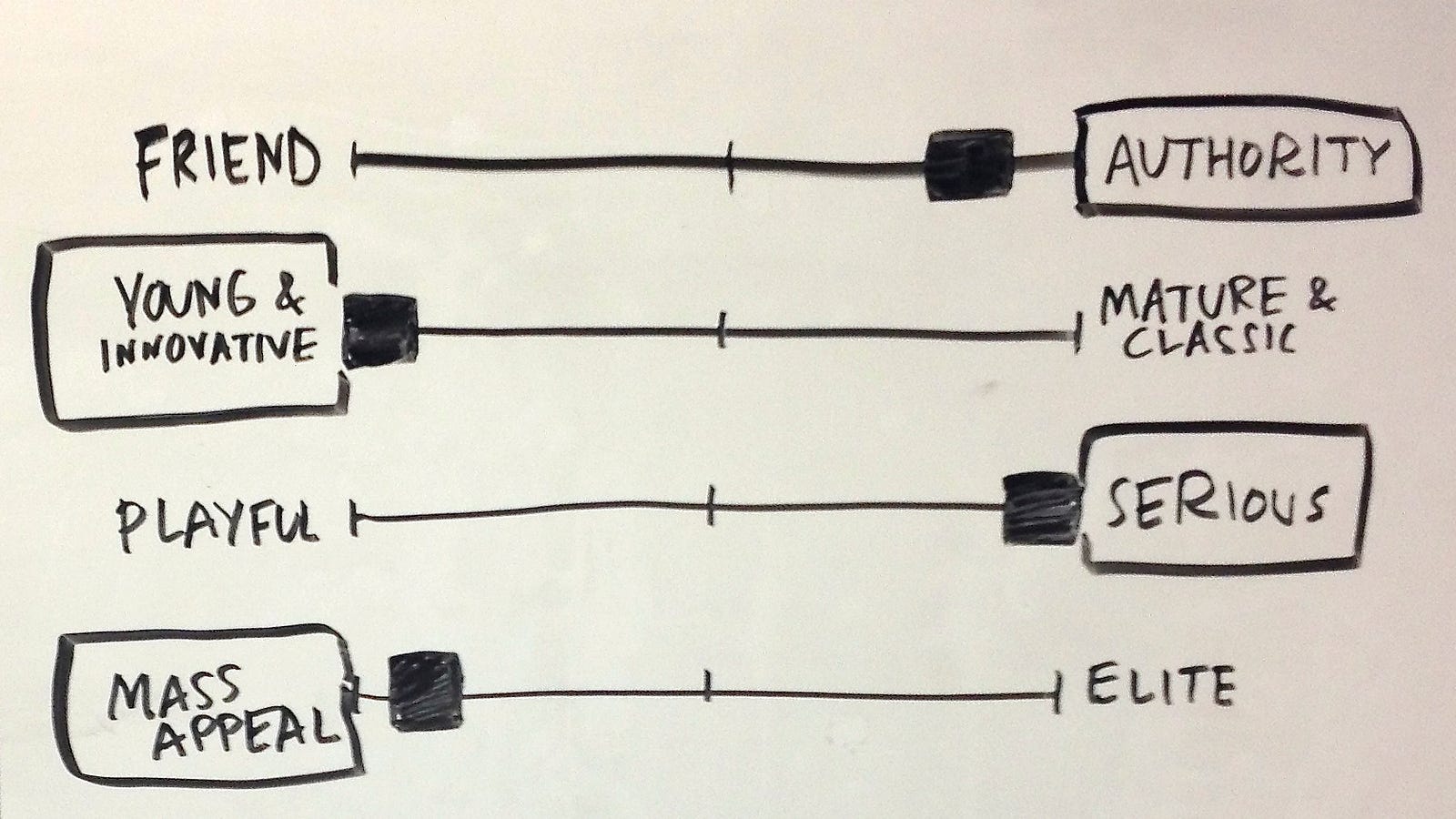
After you are finished with the "sliders" for your company/brand/product/service prioritise them and combine them to create 2x2 matrices. Identify the different and most important competitors in the market placing them in the matrices.
Review: Review the results. Have you can you identify a gap? Are you too close to your competitors. Do you need to position yourself differently. Iterate on your personality.
Brand Filters / Attribute Matrix (40 mins): You can now get a feel for how your Brand should look, speak, and behave. Now you have to put it to use. The Brand Filter / Attribute Matrix helps to take the abstract words and turn them into concrete experiences through symbols, sounds, typography, photograph, color, language and movement.
Take the prioritzed maps and describe how or show how you will bring the words to life through the different elements.
Examples:
Nike Football
Nike Football App, A Branded Experience

Photography Barnes & Noble: